
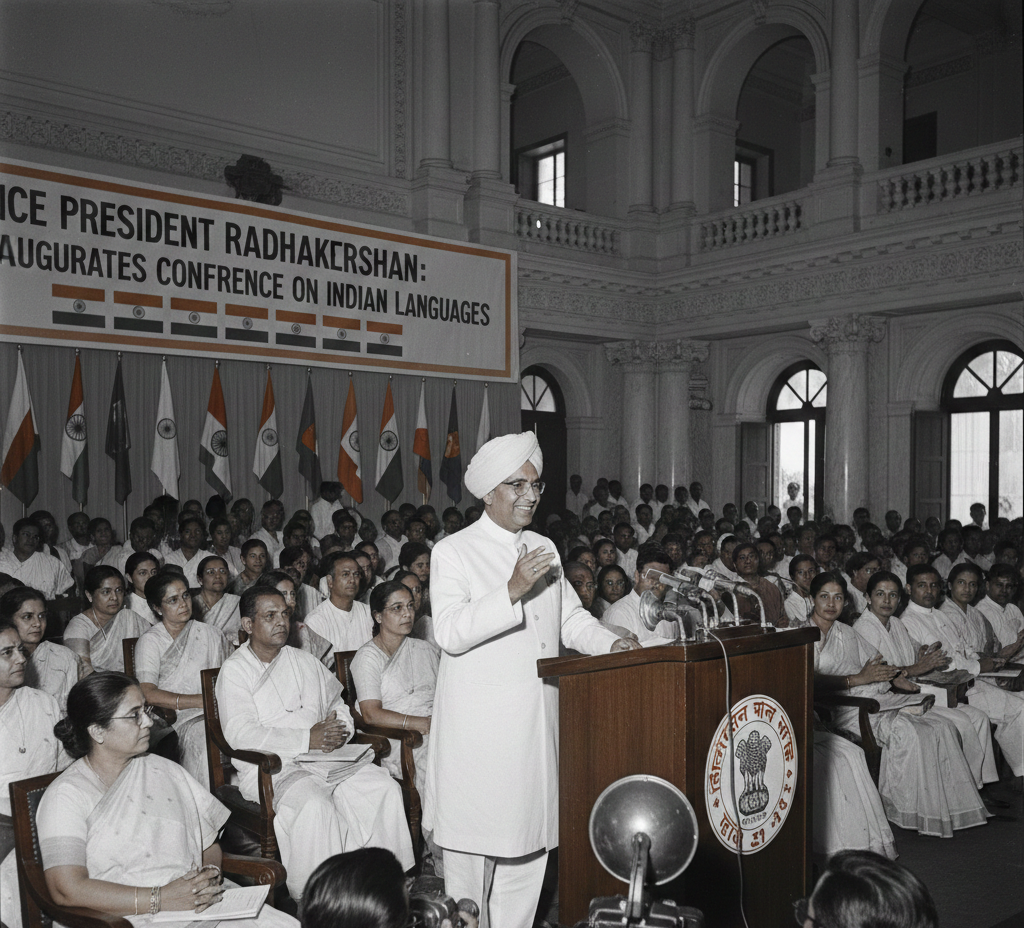
Vice President Radhakrishnan inaugurates a conference on Indian languages to celebrate and strengthen India’s rich linguistic heritage. India is a country of many languages, each carrying its own history, culture, and identity. The event brought together scholars, language experts, and international delegates to discuss the protection, study, and global promotion of Indian languages. Vice President Radhakrishnan Inaugurates Conference on Indian Languages emphasized that languages are not only tools of communication but also the foundation of culture, democracy, and knowledge.
About Dr. Sarvepalli Radhakrishnan
Vice President Radhakrishnan Inaugurates Conference on Indian Languages was one of India’s greatest philosophers, teachers, and statesmen. He was born on 5 September 1888 in Tamil Nadu and devoted his life to education, philosophy, and the service of the nation. Because of his deep respect for teachers and learning, his birthday is celebrated every year as Teachers’ Day in India.
He was a scholar of Indian philosophy and worked to spread Indian culture and spiritual values across the world. He served as India’s first Vice-President and later became the second President of India. He strongly believed that education and language play a vital role in building a strong and united nation.
Purpose of the Conference on Indian Languages
The main purpose of the conference was to promote and strengthen the use of Indian languages in education, administration, and daily life. It aimed to encourage people to take pride in their mother tongues and preserve India’s rich linguistic and cultural heritage.
The Vice President Radhakrishnan Inaugurates Conference on Indian Languages also focused on developing Indian languages for modern fields such as science, technology, and higher education. By bringing together scholars, writers, and language experts, the conference sought to find new ways to improve learning materials, translations, and communication in Indian languages for the benefit of the entire nation.
Inauguration Ceremony
The conference on Indian languages was formally inaugurated by Vice President Dr. Sarvepalli Radhakrishnan in a dignified and inspiring ceremony. Scholars, writers, teachers, and language experts from across India gathered to attend the event. Dr. Radhakrishnan lit the ceremonial lamp and officially declared the conference on Indian languages open.
In his inaugural address, he welcomed the participants and praised their efforts to preserve and promote Indian languages. He spoke about the importance of using regional and national languages for spreading knowledge and strengthening India’s cultural unity.
Key Points from Vice President Radhakrishnan’s Speech
Dr. Sarvepalli Radhakrishnan highlighted the importance of Indian languages in shaping the nation’s identity. He said that language is not just a means of communication but a carrier of culture, values, and traditions. He encouraged people to respect and use their mother tongues in everyday life.
He also emphasized that education becomes more meaningful when it is given in one’s own language. Dr. Radhakrishnan suggested that scientific, technical, and literary works should be translated into Indian languages so that knowledge can reach every section of society. His vision during the conference on Indian languages reinforced the need for cultural pride and national progress.
Importance of Indian Languages
Indian languages are the foundation of the country’s rich culture and heritage. They reflect the history, traditions, and values of different regions of India. Through these languages, stories, literature, and ancient knowledge have been passed down from one generation to another.
They also help in creating unity among people by allowing them to express their thoughts and feelings in their own mother tongue. When people learn and work in their own language, they understand ideas more clearly and confidently. By preserving and promoting Indian languages, India can protect its cultural identity while also building a strong and educated society.
Role of Education and Technology in Indian Languages
Education plays a vital role in promoting Indian languages. When schools and colleges teach students in their mother tongues, learning becomes easier and more effective. It helps students understand concepts better and builds a stronger connection with their culture and traditions.
Technology also supports the growth of Indian languages. Digital books, online classes, mobile apps, and translation tools make it possible to share knowledge in many languages. Through technology, Indian languages can be used in modern fields like science, engineering, and research, helping them grow and remain relevant in today’s world.
Impact of the Conference on Indian Languages
The conference on Indian languages inaugurated by Vice President Radhakrishnan created strong awareness about the importance of Indian languages in national development. It encouraged scholars, teachers, and policymakers to take active steps to promote the use of Indian languages in education, administration, and communication.
The discussions and ideas shared during the conference helped in developing plans for creating textbooks, research materials, and translations in Indian languages. As a result, the event played an important role in strengthening India’s linguistic unity and preserving its cultural heritage for future generations.
Conclusion
The vice President Radhakrishnan Inaugurates Conference on Indian Languages take a significant step toward preserving and promoting India’s linguistic heritage. His vision highlighted the importance of using Indian languages in education, literature, and modern fields like science and technology.
The conference not only inspired scholars and educators but also emphasized the need for collective efforts to develop and protect India’s languages. By valuing and nurturing our mother tongues, India can preserve its culture, strengthen national unity, and ensure that knowledge reaches every corner of the country.